Bruises, Breaks, and Zero Statues: The Academy's Longest-Running Injustice
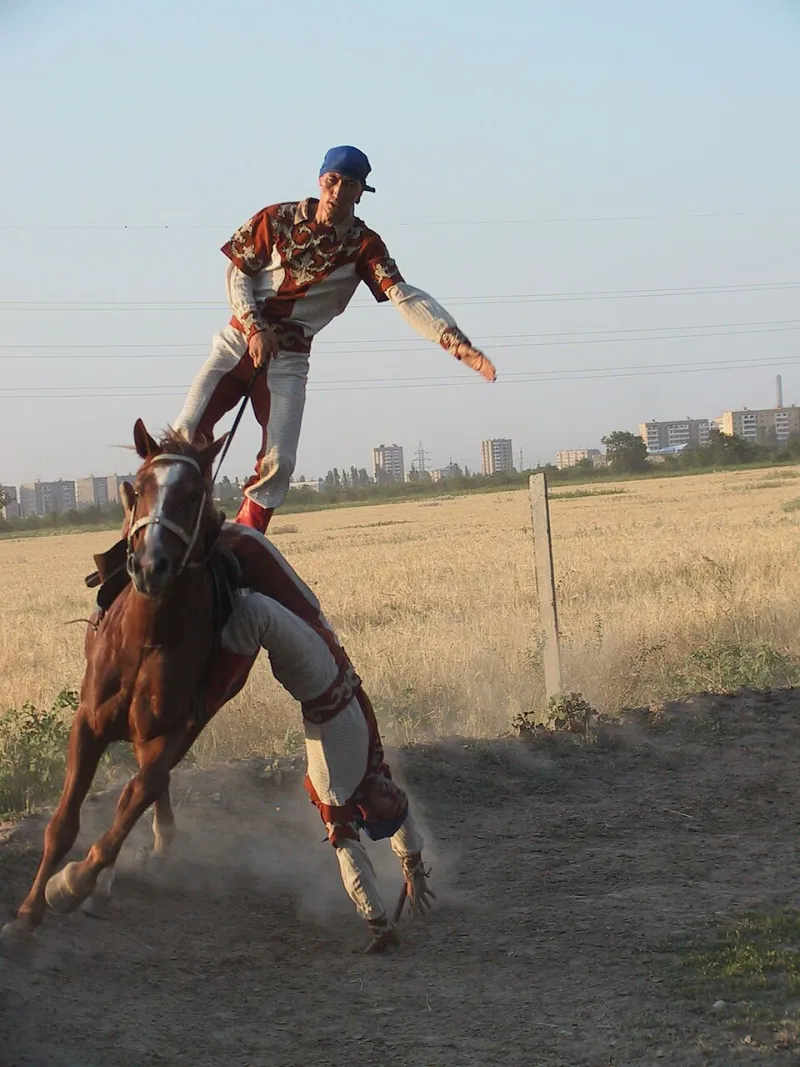
Photo: Beksultandikambaev, CC BY-SA 3.0, via Wikimedia Commons
Here's a fun party fact the next time the Oscars come up: in nearly a hundred years of Academy Awards, the people who get hit by cars, set on fire, thrown through glass, and dropped off buildings for a living have never once been recognized with a competitive category. Not one. Costume designers got their category in 1948. Sound effects editors got one. Even the relatively recent category for visual effects has been handing out statuettes since 1939 — often for work that exists to make stunts look bigger than they already are.
The people doing the actual falling? Nothing. Zero. Not even a technical award buried in the Scientific and Technical ceremony.
A Century of Invisible Work
The stunts themselves date back to the silent era, when performers like Buster Keaton did things to their bodies that modern insurance agents would faint over. Keaton famously fractured his neck on the set of Sherlock Jr. and didn't discover it until years later. Yakima Canutt, the godfather of American stunt work, choreographed the chariot race in Ben-Hur and basically invented the modern car stunt. His protégés trained generations of performers who went on to double everyone from John Wayne to Indiana Jones.
And through all of it — a hundred years of broken bones, burns, and near-misses — the Academy has treated the discipline like it doesn't exist. The standard defense is that stunts are too hard to judge. This is, to put it kindly, nonsense. The Academy judges sound mixing, a craft 99% of voters cannot meaningfully evaluate. They judge short films, live-action shorts, animated shorts. They can figure out how to assess a well-executed stunt sequence. The will simply isn't there.
The Case Study: John Wick
If you want to understand why this omission has become indefensible, watch the John Wick franchise with your eyes open. Chad Stahelski — himself a former stunt performer and Bruce Lee's double — built an entire cinematic universe on the backs of stunt professionals. The franchise's long-take fight choreography, its gun-fu precision, its willingness to let Keanu Reeves train for months and perform most of his own action: none of it works without a stunt team functioning at the level of choreographers and co-directors.
Top Gun: Maverick made the argument even more bluntly. The film's entire marketing campaign was built on one fact: the actors really flew the jets. Practical aerial work wasn't a footnote — it was the product. The movie made nearly $1.5 billion dollars, in part, because audiences had been told that what they were watching was real. Somebody performed that reality. It wasn't the director.
The Industry Knows. It Just Won't Act.
Here's what makes the stonewalling so galling: everyone in Hollywood quietly admits the truth. Stunt coordinators are increasingly credited as second unit directors. A-list actors spend a third of their prep time in stunt training and talk about it in every interview. Documentaries like Wall-to-Wall and profiles of veterans like Heidi Moneymaker — who doubled for Scarlett Johansson across the entire Marvel run — have made the craft visible to general audiences in a way it never was before.
The Academy has even acknowledged the pressure. In 2023, the organization announced plans to create a stunt design category, with the first awards potentially arriving in 2028. Which is a lovely gesture, except that the same announcement has been made, in various forms, for the better part of two decades. Stunt performers have heard the promise before. They'll believe it when the envelope is opened.
The honest explanation is probably unflattering: awards follow prestige, and prestige follows visibility. Stunt performers are, by design, not seen. Their job is to make someone else's face the one you remember. An industry built on celebrity has a hard time honoring the people whose entire art form is erasing themselves.
What a Category Would Actually Change
Critics of a stunt Oscar argue it would incentivize dangerous behavior — that rewarding stunts might push performers toward greater risk. But the industry already rewards bigger stunts with bigger paychecks and bigger box office. A category with clear criteria — choreography, storytelling through action, camera integration — would more likely push productions toward safer, better-planned, more professional work. Recognition tends to professionalize. It's the invisibility that breeds corner-cutting.
There's also a simple labor argument. Stunt performers are crew members who put their bodies on the line for every production, and their work is foundational to some of the highest-grossing films ever made. Every other major craft department gets a night in the spotlight. The people who fall down stairs for a living get a credit buried at the end of the crawl, if they're lucky.
The Fall Guy movie — itself a loving tribute to stunt performers — made more noise about this issue than any awards campaign ever has. Audiences are ready. The industry knows it. The only question left is how many more years the Academy is willing to look at a stunt performer's name in the credits and pretend it isn't one of the great dramatic arts of cinema.
Give them the Oscar. They've earned it a hundred times over — mostly by landing on things.